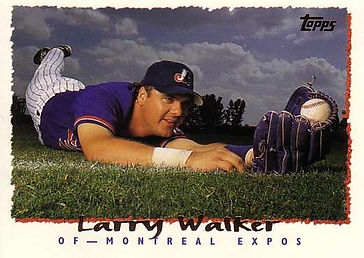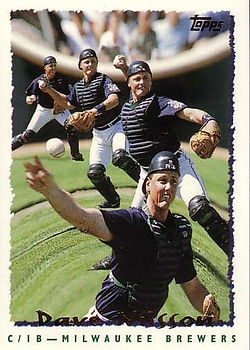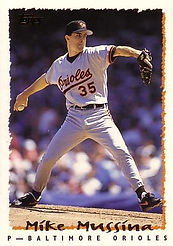

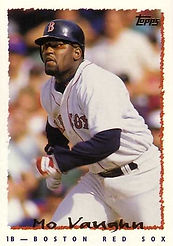


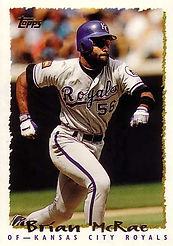


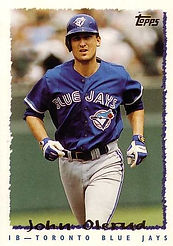

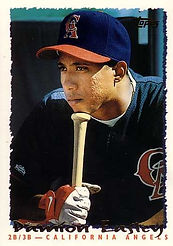


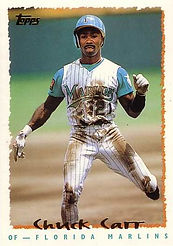





In 1995, it became clear Topps had left behind the staid past for good. A bold, cutting-edge design, great photography, more inserts and the introduction of the now-de rigueur Hobby Exclusive packaging all marked the fact Topps had finally joined its competitors in the 'modern' market. After dropping its card total from 825 in 1993 to 792 in 1994, Topps dropped its count to the old standard of 660 in 1995. Were they hedging their bets against a potential diminished collector interest following the shutdown of the 1994 season? Perhaps, but more likely it was result of a greater focus on their other card lines. Again, the set was issued in two series.
As I had for several years, I built my set in 1995 by ripping packs. These were the days where you could still find packs in drug stores, and I recall stopping regularly at the CVS near where I lived in Maryland to grab a few each week.

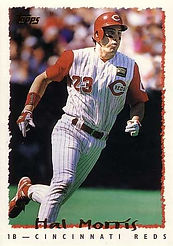
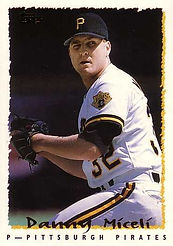
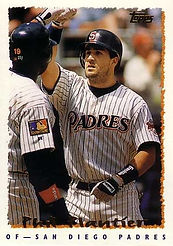
The image on the card's face is large and takes up almost the entire card. It is surrounded by an effect making it look as if it was torn from something larger, and features a colored 'shadow' along the bottom and right edges (colors correspond to teams). The player's name appears in gold foil lettering that straddles the bottom of the image and the empty space below. The player's position and team name are positioned in small text at the bottom. The Topps logo appears in gold foil in either the upper right or left corner of the image.
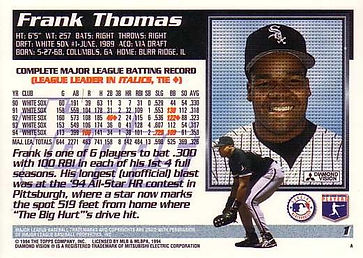
Card backs feature a large Diamond Vision jumbotron-like image of the player along with a smaller cut-out photo of the player in the foreground. The player's name and vitals appear at the top against a background colored in a manner which is consistent for all the cards from the same team. Statistics and a narrative appear below.
The use of gold foil for the names on the front again makes it difficult to read names at a glance, and this is aggravated by the unconventional font in which the lettering appears.
Topps again used a glossy finish that causes 'bricking' or binding of the cards together when stored unopened for long periods of time.
Series 1: Cards 1-396
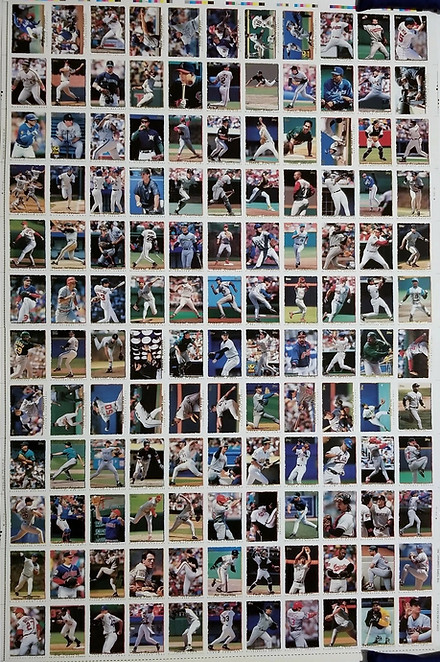
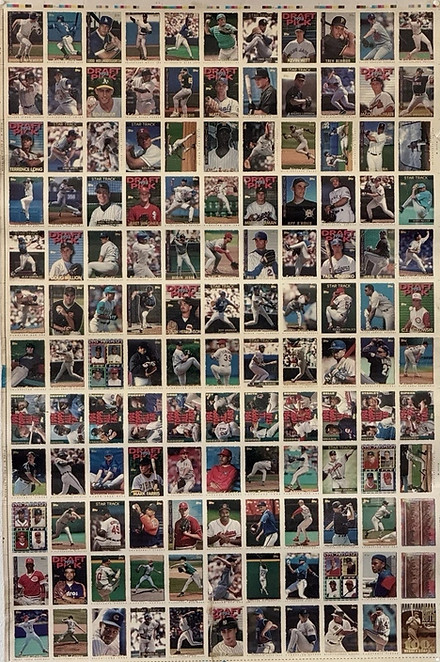
Series 1 was printed on 3 slits of 132 cards each. On the left above is the A/B sheet - the top six rows of 11 cards carry the A print code on the reverse and the bottom 6 rows carry the B. On the right is the E/F sheet, with 66 E cards on top and 66 F cards below. No images of the C/D sheet can be found.
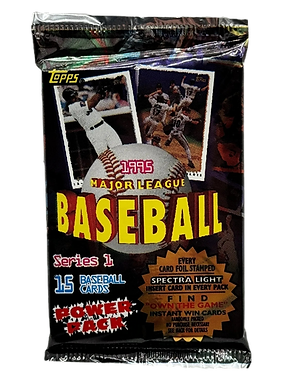
Basic series 1 foil packs contained 15 cards and came 36 per box. One card per pack was a 'Spectra Light' Cyber Stats card (see below). Packs could also contain a League Leader insert card or an "Own the Game" instant win card.
_edited_p.png)
.jpg)
.jpg)
_ed.png)
New for 1995 was 'hobby exclusive' packaging - specially marked foil packs available only at hobby stores. Hobby exclusive packs did not feature League Leader cards, but did offer the chance to pull a Stadium Club 1st Day Issue card. Presumably Topps started this practice in an effort to goose business at the nation's growing number of sports card stores.
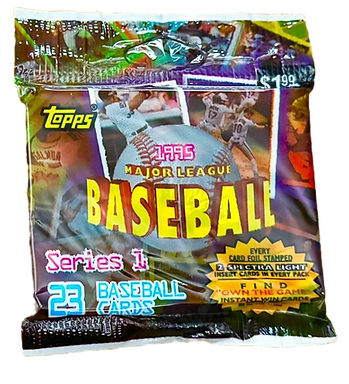
23-card hanger packs carried a $1.99 price and included 2 Cyber Stats cards. Packs came 24 per box.
.jpg)
_edited.png)
_edited_.png)
_.png)
36-card jumbo packs contained 3 Cyber Stats cards each and came 24 packs per display tray. Each case contained a single tray.
30-card rack packs contained 2 Cyber Stats cards each and came packed 24 per box.
_e.png)
_edited_p.png)
24-card packs came with 2 Spectra Light cards and a stick of gum. They were packaged 20 per box.
The gum came wrapped in foil and paper, much like a typical stick of gum.


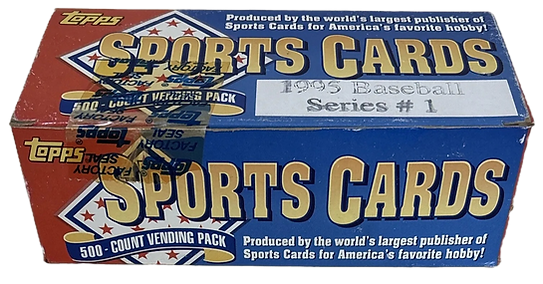
Traditional 500-count vending boxes were also available. It is likely that a small number of the 500 cards were Cyber Stats card, but we don't know this for sure.
Of series 1's 396 cards, 336 are basic individual player cards. Included in this count are five of the ten members of the 1994 Topps All Star Rookie team. The remaining five appear in series 2. Those included in series 1 are:

143 - Bob Hamelin, Royals 1B
277 - Chris Gomez, Tigers SS 324 - Ryan Klesko, Braves OF
180 - Raul Mondesi, Dodgers OF
54 - Joey Hamilton, Padres RHP


Card 3 commemorates what would have been Babe Ruth's 100th birthday year. The back gives a description of the man and his accomplishments and provides career and World Series pitching and batting stats. A variation exists (below) where the Topps logo was inadvertently left off the card front.


Series 1 includes 15 Future Stars cards. Each of the featured players Topps projected for success but whom had yet to make his MLB debut. Backs contain vitals, a narrative and career minor league stats.
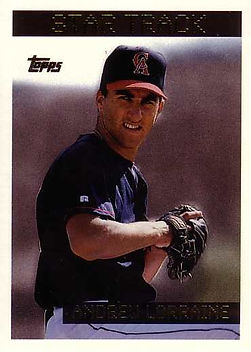
12 cards are Star Tracks - budding stars within minimal MLB experience.

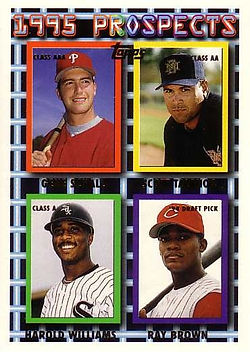
Series 1 includes four 4-player prospect cards. Each features four players with no MLB experience, one each from AAA, AA, A and one taken in the 1994 draft. Card backs feature their career minor league stats. Pitchers appear on separate cards from regular position players.


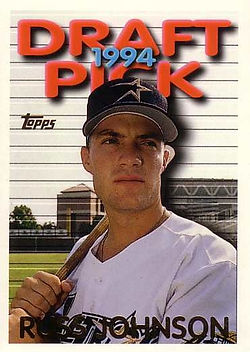
15 cards depict players taken in the first round of the 1994 draft. Card backs offer their high school or collegiate statistics and a brief narrative.

Cards 384-394 feature players deemed by Topps to have been the best at their positions in 1994. Each of the 8 basic defensive positions are included, as well as left and right handed starters and closers. Card backs show each player's first half, second half and total 1994 statistics - the second half numbers being diminished due to the season's cancelation.

Cards 395 and 396 are checklist cards which mark series 1 off in increments of 198: 1-198 and 199-396.
A full checklist of the entire 1995 set, in a variety of printable formats, can be found at the Trading Card Database HERE.


Series 2: Cards 397-660
At 264 cards, series 2 would have been printed on two 132-card sheets - a G/H sheet and an I/J sheet. No images of either are currently available.
.jpg)
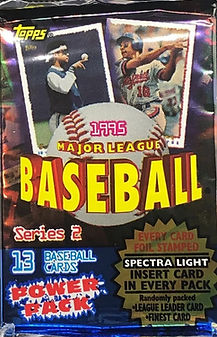
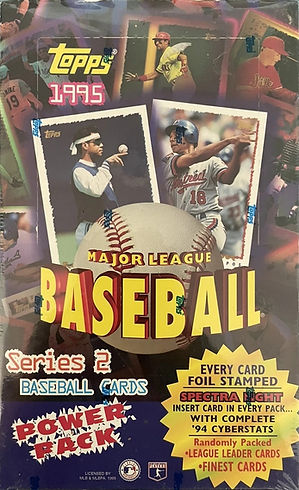
Series 2 foil packs held 13 cards - 11 regular and 1 Cyber Stats card. Also available were League Leader and Finest Total Bases insert cards. Boxes held 36 packs.
.jpg)
.jpg)
.jpg)
As with series 1, special Hobby Exclusive foil packs were issued for series 2. No League Leaders cards were available, but randomly-inserted Stadium Club 1st Day Issue cards were.
Series 2 cards were also available in $1.99 20-card hanger packs containing 18 regular and two Cyber Stats cards. No box images are available, but it is likely they contained 24 packs.
.jpg)
.jpg)
_edited_p.png)
Series 2 rack packs contained 28 cards, two of which were Cyber Stats cards. Boxes contained 24 packs.
_e.png)
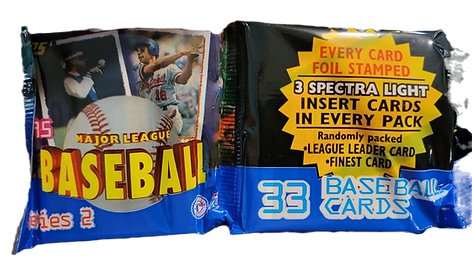
Series 2 jumbo packs held 33 cards, including three Cyber Stats cards. Packs came 24 per counter display, and each case held a single display box.
.jpg)
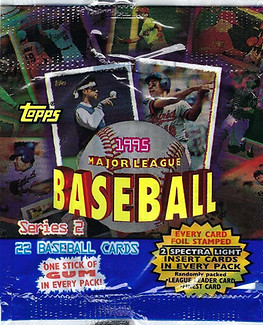
Series 2 cards could also be found in 22-card hanger packs which included 2 Cyber Stats card and a stick of gum.
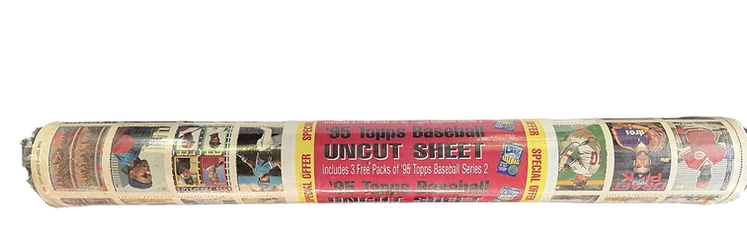
An odd packaging variety were three series 2 packs wrapped inside series 1 uncut sheets. It is unclear whether each package held only a single series 1 sheet or all three sheets rolled together.
While imagery is lacking, it is almost certain that series 2 was also available in 500-count vending boxes.
Of 264 total series 2 cards, 210 are basic individual player cards.
Included in the basic player card count are five cards highlighting those members of the 1994 Topps All Star Rookie team not included in series 1.

574 - John Patterson, Giants 2B
451 - Jose Oliva, Braves 3B
577 - Manny Ramirez, Indians OF
567 - Javy Lopez, Braves C
542 - Brian Anderson, Angels LHP
Series 2 contains an additional 18 cards featuring players taken in the first round of the 1994 amateur draft.
Series 2 contains 6 4-player Prospects cards highlighting players with no MLB experience. Cards feature draft picks as well as players at the A, AA and AAA levels.


Cards 631-658 are special On Deck cards. One for each club, these cards feature two prospects who had not yet reached MLB but whom Topps thought showed potential.


Cards 659 and 660 checklists. They mark series 2 out in increments of 132: 397-528 and 529-660.
No Hall of Famers make their debut in the 1995 base set, but Johnny Damon (599), Troy Percival (633) and Andy Pettitte (640) do appear for the first time.
Hall of Famers Dave Winfield (158) and Alan Trammell (474) appear for the final time, as do Lou Whitaker (15), Tim Wallach (38), Harold Reynolds (69), Howard Johnson (206), Bob Welch (364), Kirk Gibson (519) and Bo Jackson (592).


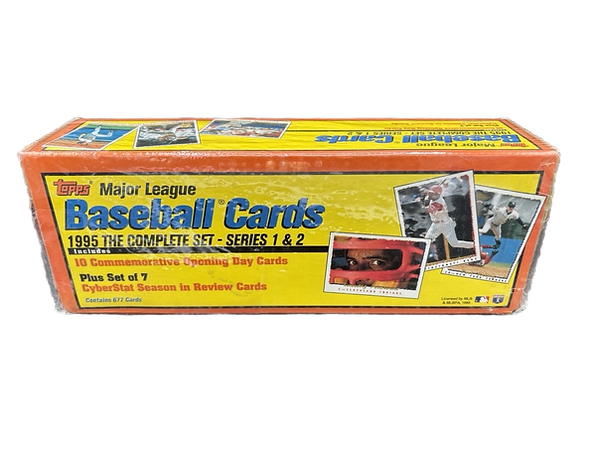
The basic factory set package contained two special insert sets.
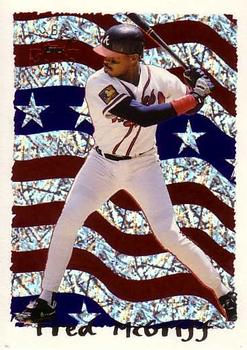
Topps Cyber Stats Season in Review (7 cards) offered hypothetical scenarios had the 1994 season been played to its normal conclusion (NLDS MVP, World Series MVP, etc.). Card fronts featured players set against an American Flag-ish background with a Spectra Light finish (in one instance, they were quite prescient - one card imagined a one-game playoff for the 1994 AL West title, a scenario which came to pass in 1995).



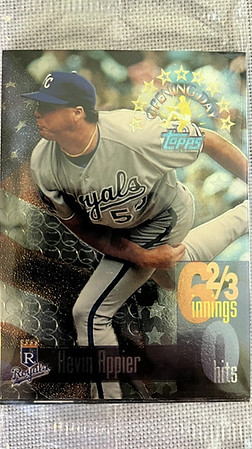
The other set was a 10-card Opening Day set which highlighted some outstanding performances from the first slate of games in 1995.
There was a Hobby Exclusive factory set which included the Cyber Stats Season In Review set, along with 10 randomly selected Stadium Club 1st Day Issue cards.


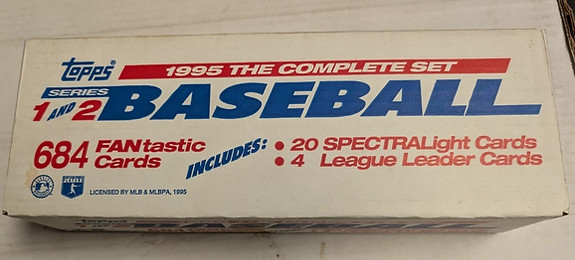
Also issued was a plain-looking factory set packaged which included 20 Cyber Stats and 4 League Leader cards in two cellophane packs.


This odd thing - a factory set package containing only series 1 and what looks like a single cellophane pack of Cyber Stats and League Leader cards - was available only to retailers/dealers via Topps' Grand Slam dealer promotion, a program in which Topps tried to get them to order a variety of Topps products aside from cards - candy, etc.
The box had room for series 2 which, it was announced, would be available with something called "Grand Slam 2". And, as promised, a small box containing series 2 was available at some later point.


The Cyber Stats set, available on a per-pack basis across both series in all packaging formats, totaled 396 cards (198 in series 1 and 198 in series 2). Each card is a not-quite parallel of the player's base card. On the front, the background is overlaid in a metallic finish. Card backs offer calculations of what the player's final stats might have looked like had the 1994 season gone the full 162 games.


The League Leaders insert set consists of 50 cards, with numbers LL1-LL25 issued with series 1 and numbers LL26-LL50 in series 2. League Leaders were available in all packaging formats except Hobby Exclusive packs.
Cards depict the top 5 performers in each league across five statistical categories - average, HR, RBI, stolen bases and strikeouts.


The 15-card Finest Total Bases set was available across all non-Hobby Exclusive series 2 packaging formats. Featured are 1994's top 15 players in total bases production. Card fronts were masked by a clear plastic film to prevent scratches.
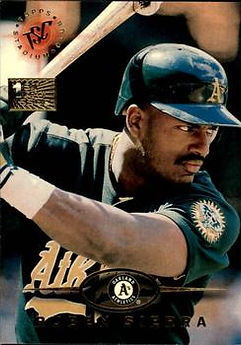

A selection of nine series 1 1995 Stadium Club cards with special 1st Day Issue gold markers on the front were available in series 1 Hobby Exclusive packs. These nine available players are:
Shawon Dunston (29)
Paul Molitor (39)
Bob Hamelin (79)
Ruben Sierra (96)
Will Clark (131)
Mike Piazza (149)
Andy Van Slyke (153)
Jeff Tackett (168)
Ivan Rodriguez (197)
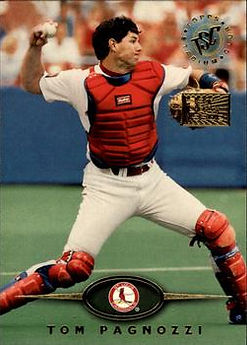
All series 1 1995 Stadium Club cards (270 in all) were available in special 1st Day Issue varieties in series 2, including the nine featured in series 1.


The Bob Hamelin card available in series 1 Hobby Exclusive packs does not include the AL Rookie of the Year feature that appears on his regular 1995 Stadium Club card. The Hamelin card available in series 2 does.

All series 1 packaging varieties included the chance at an "Own the Game" Instant Winner card. Odd of finding a card in 15-Card Series 1 "Power Packs" were 1/120. Odds differed for each pack size. Each card identified a prize won by the holder at one of five prize levels:
4th Prize - A team set of 1995 Cyber Stats cards
3rd Prize - Either a complete AL or NL Cyber Stats set
2nd Prize - A complete set of all 396 Cyber Stats cards (500 available)
1st Prize - Fifty winners would receive a set of 100 personalized 1995 Topps baseball cards featuring the winner's picture and personal information. Winners would be sent an official team uniform of their favorite club and a single use camera to take their photo for the cards.
Grand Prize - A single lucky winner would get a Topps "Own the Game" baseball passport. The passport would entitle the winner and a guest to attend MLB games of their choice between 7/4/96 and 9/4/96. Included were game tickets, up to 100,000 total domestic coach air miles, up to 60 nights hotel accommodations and $5,000 in spending money.


.jpg)
The 1995 Topps Traded and Rookies set was available only in pack form. Packs held 11 cards and boxes held 36 packs.
.jpg)

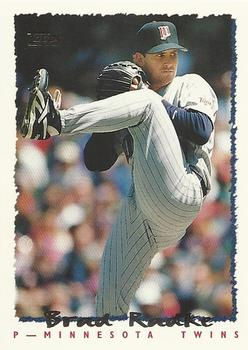
The 165-card set contained 115 individual basic player cards. Also included were...
...ten At the Break cards (cards 1-10) detailing how certain stars had performed in 1995 by the time of the All Star break...
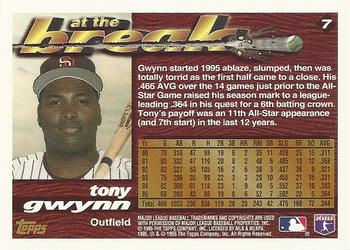
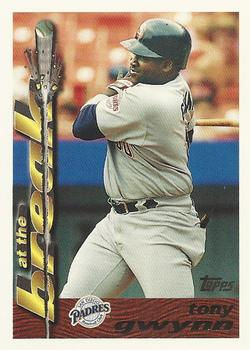


...12 Rookie of the Year Candidates cards, showcasing the minor and major league highlights of 12 players Topps thought were the prime ROY contenders in 1995...
...14 Draft Pick cards featuring players taken in the first round of the June, 1995 draft...


...two 4-player Prospects cards...

...2 On Deck cards, not team-specific as with those in the basic set...

...A single Star Track card of the Dodgers' Hideo Nomo (who is also featured on a Rookie of the Year Candidates card)...


...Nine mid-year All Star cards (#s 156-164) featuring the players Topps felt had performed best thus far at their positions in 1995...

...And a single checklist card.
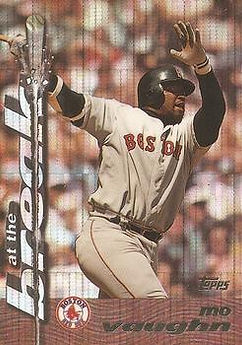

A special insert set of the 10 At the Break cards printed on thick, shiny special effect stock was randomly inserted into Traded and Rookie packs.


Hall of Famers Carlos Beltran and Mariano Rivera (130T) make their first appearances in the 1995 Traded and Rookies set. Beltran's image was printed on the card of fellow draft pick Juan LeBron (12T) and LeBron's appears on Beltran's card (18T).
Stalwart pitching star Dave Stewart (154T) makes his final appearance.


A number of cards in the 1995 set were printed with a horizontal orientation and some featured unique and even special effect images.