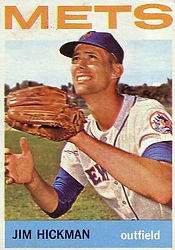

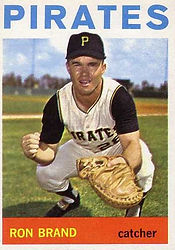


When I was taking confirmation classes (shout out to the Lutheran Church Missouri Synod) in about 1981 or so, a classmate brought in a stack of some 1964 cards. This was the first time I'd seen any '64 cards. They had belonged to his older brother, and he was fine giving most of them away. But, he kept all the Yankees, among which was a Mantle. I did get a few other stars - Hank Aaron and Brooks Robinson among them. If I recall correctly, I traded most of the haul away shortly thereafter for a 1981 Fleer complete set. Not one of my better deals.
1964 was the final year for Houston Colt .45 cards - in the off season they changed their name to Astros. I wish they'd put the club's complete name on the card fronts instead of just "Colts".

The player's image is bordered along the top by the team name spelled out in bold, bright capital letters. 1964 is the first year in which Topps gave each club's cards a uniform color design, permitting easy sorting of the cards by team.
Beneath the photo is a colored bar featuring the player's name and position.
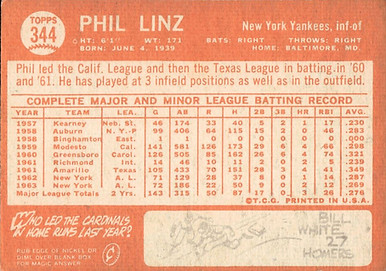
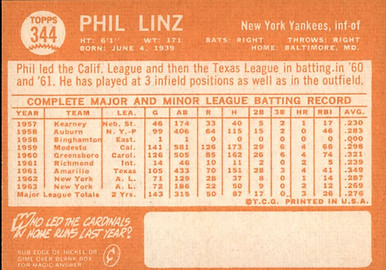
Cards are printed on white stock which, when combined with the orange coloring on the reverse, makes them look like a creamscicle. The player's vitals appear along the top, his statistics in a large box in the middle, and, at the bottom, a real novelty. The answer to a trivia question is hidden in a white box, against which a coin can be rubbed to reveal the answer.
Curiously, when rubbed no residue comes off the card, and the coin never seems to leave much of an indentation. It seems 1960s' scratch-off technology was pretty advanced. Another by-product of the space age, no doubt.


Standard wax packs held 5 cards (plus a stick of gum) and sold for 5 cents each. Boxes contained 24 packs, and cases contained 24 boxes.
Wax wrappers came in two designs - one plain, and one advertising metal coin inserts.
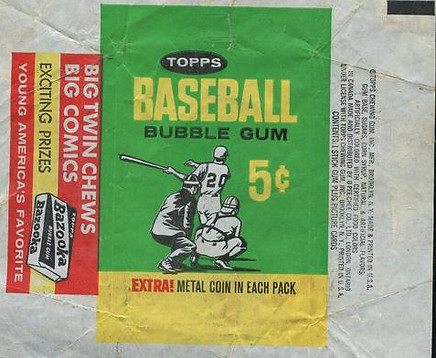


Wrappers featured one of five side panel ads: (from left) 1) a general advertisement for Bazooka chewing gum, 2) an "exploding" battleship toy for 175 Bazooka comics or 35 cents and 5 comics, 3) a cowboy boot ring with a compass, magnifying glass and other features for 150 comics or 35 cents and 5 comics, 4) a sea shell "hobby kit" ("20 real shells gathered from the 7 seas!") for 175 comics or 35 cents and 5 comics, or 5) a ring designating the holder as a member of a 'secret' Topps club for 175 Bazooka or Blony comics or 35 cents and 5 comics. The ring ("Engraved, gold-plated, fits all fingers") contained a stamp in the shape of holder's initial, and came with a wallet-sized charter member ID card and a certificate suitable for framing.
Both wrapper types are known to have been issued with each of the 5 side panel ads.

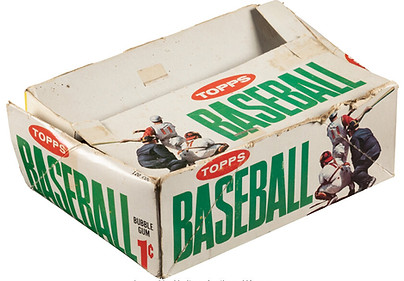
Wax boxes, like packs, came in two varieties - one plain and one carrying an advertisement for the coin inserts. The image to the left shows a period store counter with the plain variety on display in the lower right.
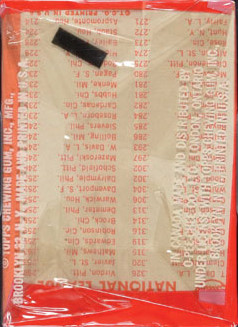
Cases, like boxes and wrappers, also likely had two versions, but the only imagery we have presently is of this case which contained boxes and packs with coin inserts.


The set of 'coin' inserts totaled 164 in total. Coins depicting National League players used a silver finish, and those depicting American League players used gold.
Coins 121-164 depicted "1964 All Stars" from both leagues. Coins 121-140, as well as 161 and 162, depict A.L. stars and have a blue finish against a gold backing. Coins 141-160, as well as 163 and 164, depict N.L. starts and have a red finish against a silver backing.
_edited.png)


The coin series contains three variations. Two can likely be described as 'errors' - American League All Stars Wayne Causey and Chuck Hinton were initially issued identifying each as members of the National League on the reverse (despite the correct A.L. gold backing). When the errors were discovered, they were reissued with the correct "A.L." designations.


The third variation is of Mickey Mantle's All Star coin - it exists showing him batting both lefty and righty. Because he was a switch hitter, and because he was probably the most popular player in the set, Topps likely issued both versions under the same number (#131) on purpose.
We know that series 1 packs contained coins, but which subsequent series had them remains a mystery.

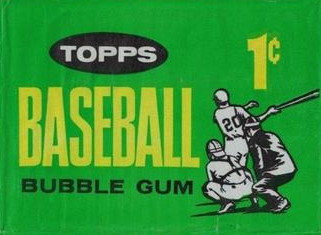
As usual, Topps issued small penny packs which contained a single card and a stick of gum. Boxes contained 120 packs.
Two different penny pack wrapper styles were used in 1964 - one featuring the usual repeating image format and another with a single, centered image and featuring ads for 1964 5 cent packs and the coins they contained.


Cello packs contained 12 cards (but no gum), and were sold for 10 cents each. Boxes held 36 packs each. Series 1 packs, such as the one shown here, contained 2 coins each.
From this we can surmise series 1 wax packs contained one coin each. This conclusion is bolstered by the fact the wax case shown above carries a packing date of February 4, 1964.
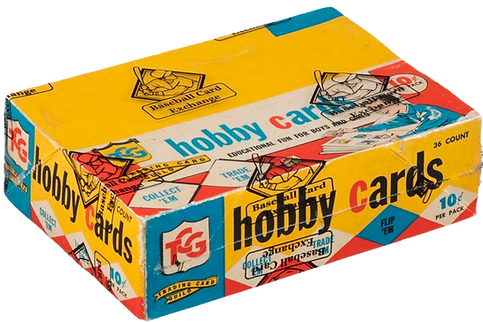
This sell-sheet makes it plain that 6-pack grocery packs were issued, but we currently are lacking for images of any actual packages.
3-cell rack packs were also likely available, as they were in earlier years, but confirming imagery is unavailable.
.jpg)
500-card vending boxes were available as usual.

The 1966 set contains 587 cards issued across 7 series. It contains 455 individual basic player cards and a variety of specialty subsets.
Included among the 455 basic player cards are the ten players from the 1964 Topps All Star Rookie team. Each is designated by a small gold trophy on their card.

109 - Rusty Staub, Colt .45s 1B
125 - Pete Rose, Reds 2B
168 - Al Weis, White Sox SS*
85 - Pete Ward, White Sox 3B
73 - Jimmie Hall, Twins OF
435 - Vic Davalillo, Indians OF
330 - Tommy Harper, Reds OF 457 - Jesse Gonder, Mets C**
412 - Ray Culp, Phillies RHP
130 - Gary Peters, White Sox LHP
* - Weis's card indicates a dual position of SS and 2B. He played 76 games defensively in 1963 - 48 at 2B, 27 at SS and 1 at 3B.
** - Gonder's card doesn't display a trophy. In 1963 he appeared in just 38 games, all as a catcher, first with the Reds and then the Mets to whom he was dealt on July 1st.
Series 1: 1-109

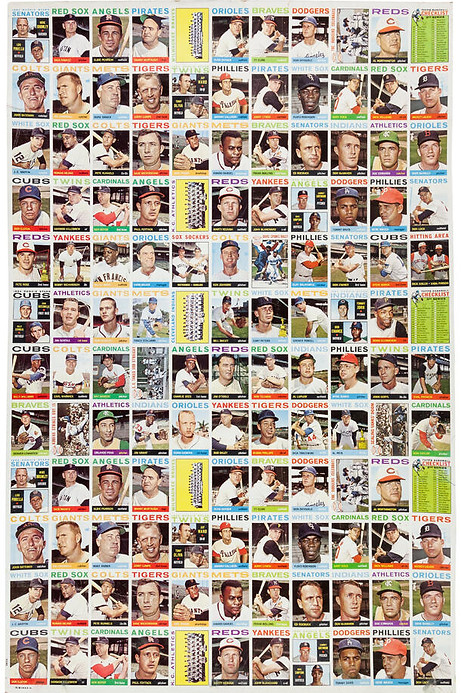
Each series was printed on a 264-card full sheet which was divided into 2 individual 'slits' or smaller, 132-card half sheets. In series 1, each slit contains 10 different rows of 11 cards for a total of 110 cards, but because the series 1 checklist is appears in 2 rows, the series contains 109 unique cards. Each slit also features 2 repeated rows, giving each slit 22 double-printed cards. This produced a total of 44 cards printed in 50% greater quantities than the rest. With 1964's first series, we actually have an image of a full sheet, rare for a set this old. This permits us to know those cards which were over-printed:
31 - Dave Nicholson
68 - Willie Davis
38 - Jim Wynn 39 - Hank Aguirre
18 - Billy O'Dell
95 - George Altman
65 - Felipe Alou
52 - Chuck Hinton
105 - Woody Held
42 - Moe Drabowsky
45 - Milt Pappas
17 - Willie Kirkland
90 - Earl Battey
24 - Carl Sawatski
97 - Jim Fregosi
27 - Mets Team Card
22 - Jerry Adair
100 - Elston Howard
47 - Giants Rookie Stars
30 - Ron Perranoski
83 - Gus Triandos
104 - Art Mahaffey
72 - Leo Cardenas
50 - Mickey Mantle
82 - Jim Davenport
89 - Boog Powell
61 - Angel Backstops
5 - N.L. Strikeout Leaders
11 - N.L. RBI Leaders
16 - John Boozer
92 - Steve Ridzik
34 - Jim Perry
41 - Friendly Foes
33 - Reds Rookie Stars
26 - Gino Cimoli
14 - Dodgers Rookie Stars
66 - Eddie Fisher
87 - Cardinals Team Card
54 - Sam Mele
109 - Rusty Staub
84 - Carl Willey
107 - White Sox Rookie Stars
20 - Bob Friend
76 - 1st Series Checklist
Of the 109 unique cards in series 1, 80 are basic player cards (including the Hall All Star Rookie), and the remaining 29 belong to one of several subsets.

Cards 1-12 feature AL and NL leaders in 6 statistical categories from 1963 - ERA, Pitching (AKA Victories), Strikeouts, Batting, Home Runs and RBI. The three or four top performers are depicted on the front, and the top 50 are listed on the reverse. The exception to this is on the HR leader cards where, in addition to the top 25 or so HR leaders, those players who hit grand slams in 1963 are listed.


Series 1 contains three team cards - the Mets, Tigers and Cardinals. Card backs display the club's 1963 hitting and pitching leaders, and provide a detailed breakdown of each pitcher's record against the other 9 clubs in the league.
For reasons which are unclear, the set doesn't contain a team photo card of the Colt .45s.


Three manager cards appear in series 1 - Yogi Berra/Yankees, Sam Mele/Twins and Walter Alston/Dodgers.
Card backs feature a narrative account of some the manager's career highlights.


Series 1 includes six team-specific 2-player Rookie Stars cards featuring youngsters with little or no MLB experience. Included are cards for the Dodgers, Reds, Giants, Pirates, Braves and White Sox.


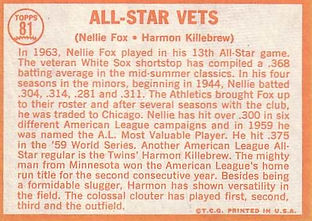

Series 1 includes three star combo cards. Reverses provide narrative accounts of the players' accomplishments.


Series 1 includes the checklist cards for both Series 1 and Series 2.
Cards listed on each checklist do not correspond exactly to cards in that particular series. Most 1964 checklists include fewer than all the cards from that particular series, and most include cards from the following series to offer kids a glimpse of what was to come.


The series 1 checklist can be found in two different versions, identifiable by the positioning of the type over the baseball on the reverse.
Not yet skilled in the art of airbrushing, or even in the addition of a "traded" line on the reverse, series 1 contains four cards featuring players suited up for their former club yet depicted with their current club, by which they were acquired too late for Topps to have obtained updated images.


Series 2: 110-196

RECONSTRUCTION
Series 2 contains 88 cards, and each series 2 slit has all 8 different rows of 11 cards plus a repeated block of 4 rows. Together, a full 264 card sheet contains each card exactly 3 times, with no over- or short-prints. With 87 unique cards (not counting a reprint of the series 2 checklist, a series 1 card), 68 are basic player cards (including the Peters, Rose and Weis All Star Rookie cards) while the rest belong to various subsets. The image on the left above is a photo of one of the series 2 slits from 1964, while the image on the right is a reconstruction of what we know the other slit looked like.

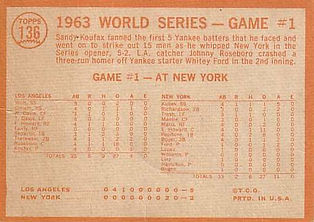
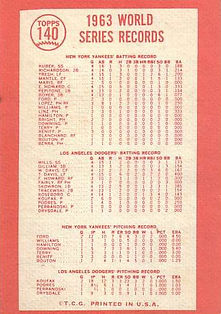
Cards 136-140 depict highlights from the 1963 World Series between the Dodgers and the Yankees. Cards 136-139 each recap a specific game, with card backs offering a brief narrative summary of the contest, offensive statistics for each club and a line score. Card 140 depicts the victorious Dodgers celebrating and features series offensive and pitching stats for each club on the reverse (bring a magnifying glass!).

Series 2 contains the Braves, A's and Indians team photo cards.
Series 2 contains three manager cards - Danny Murtaugh/Pirates, Gene Mauch/Phillies and Hank Bauer/Orioles.
Series 2 features five team-specific 2-player Rookie Stars cards. Included are the Twins, Angels, Indians, Senators and Cubs.
Series 2 contains the series 3 checklist.


Series 2 features two star combo cards.

Series 3: 197-283
RECONSTRUCTION
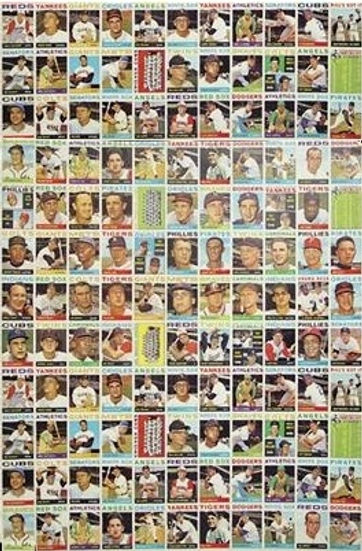
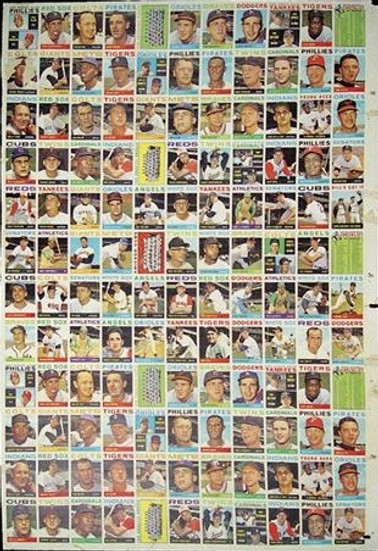
Like series 2 before it, series 3 contains 88 cards, arranged on printing sheets in 8 rows of 11. Each series 3 slit has all 8 rows plus a repeated block of 4 rows. Together, a full 264 card full sheet contains each card exactly 3 times, with no over- or short-prints. With 87 unique cards (not counting a reprint of the series 3 checklist, a series 2 card), 73 are basic player cards while the rest belong to various subsets. The image on the right above is a photo of slit B from the 3rd series, while the one on the left is a reconstruction.

Series 3 features team photo cards of the Angels, Cubs and Giants.
Three manager cards are included in series 3 - Fred Hutchinson/Reds, Al Lopez/White Sox and Johnny Pesky/Red Sox.

Series 3 has five team-specific 2-player Rookie Stars cards featuring the Orioles, Colt .45s, Phillies, Cardinals and Yankees.
Series 3 includes the series 4 checklist.


Series 3 features two star combo cards.

Series 4: 284-370
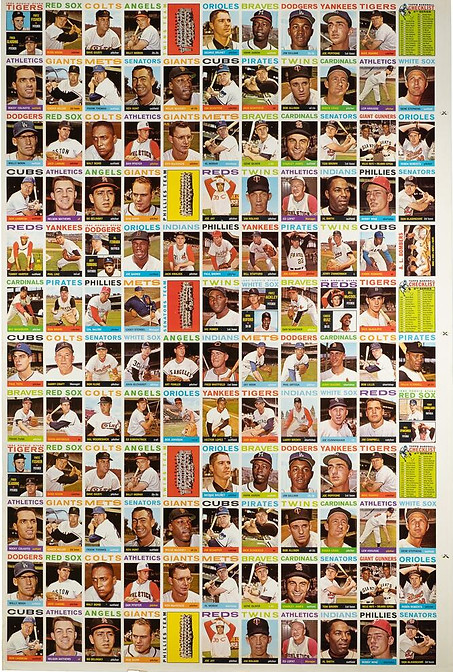

RECONSTRUCTION
Series 4 follows the same pattern as series 2 and series 3 - it contains 88 cards, with each slit having all 8 rows plus a repeated block of 4 rows. Together, a full 264 card sheet contains each card exactly 3 times, with no over- or short-prints. With 87 unique cards (not counting a reprint of the series 4 checklist, a series 3 card), 73 are basic player cards (including All Star Rookie Harper) while the rest belong to various subsets.

Series 4 features team photo cards of the Phillies, Twins and Senators. Oddly, each is formatted so that the text above the photo reads "[team name] Team" rather than simply the city and team name as is the case in the other six series.
Series 4 contains three manager cards - Harry Craft/Colt .45s, Casey Stengel/Mets and Ed Lopat/A's.

Series 4 features five team-specific 2-player Rookie Stars cards - Red Sox, Tigers, Dodgers, Reds and White Sox.
Series 4 also, of course, contains the 5th series checklist.


Series 4 has two star combo cards.

Series 5: 371-446

RECONSTRUCTION
RECONSTRUCTION
Series 5 contains 77 cards, 76 of which are unique given it contains a series 5 checklist, a 4th series card. Each slit contains 7 different rows of 11 cards and 5 duplicate rows. This resulted in 33 cards being printed in 1/3 greater quantity than the other 44. We have an poor image of the series 5 B slit. From that, slit A's appearance was deduced. Both are reconstructed above. The 33 over-printed cards are:
375 - Ron Santo
389 - Jim Umbricht
397 - Chuck Cottier
396 - Dennis Bennett
405 - Ken McBride
391 - Sam McDowell
431 - George Alusik
394 - Bob Miller
413 - Johnny Keane
445 - Bill Skowron
392 - Jim Pagliaroni
437 - Ed Bailey
376 - Dave Morehead
434 - Don Nottebart
441 - Bob Duliba
399 - Jackie Brandt
420 - Jim Maloney
425 - Norm Cash
404 - Tony Martinez
421 - Camilo Carreon
436 - Charlie Neal
418 - Orioles Rookie Stars
430 - Juan Pizarro
403 - Reds Team Card
415 - Tony Kubek
419 - Ken Harrelson
374 - Bobby Bolin
422 - Jack Fisher
416 - Lee Maye
385 - Curt Simmons
377 - Bob Skinner
393 - Casey Teaches
382 - Wes Stock
Of the 76 unique cards in series 5 (including the Culp and Davalillo All Star Rookies), 61 are individual basic player cards with the other 15 belonging to various subsets.

Series 5 contains team photo cards of the Pirates, Reds and Yankees.
Series 5 includes 3 manager cards - Bill Rigney/Angels, Johnny Keane/Cardinals and Chuck Dressen/Tigers.

Series 5 includes six team-specific 2-player Rookie Stars cards representing the Braves, A's, Mets, Cubs, Orioles and Red Sox.

Series 5 features the series 6 checklist card.


Series 5 features the set's final two star combo cards.


Jim Umbricht's card records the fact that he passed from cancer shortly before opening day. Topps likely knew he wouldn't play in 1964 given the progression of his disease; In December of 1963 the Colt .45s had signed him to a scout's contract indicating their own doubts. Teammates were his pall bearers, and one, Russ Kemmerer, who was an ordained Methodist minister, provided the eulogy. Umbricht was cremated, and his ashes scatted by plane over the construction site of the Astrodome - his family felt the new stadium "could be his headstone".
Series 6: 447-522
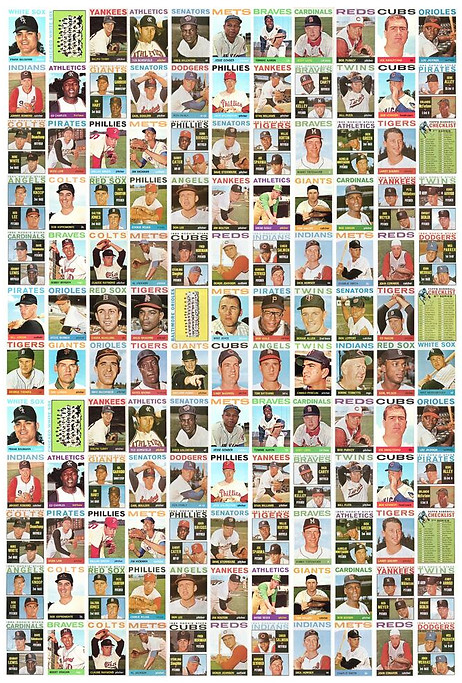
RECONSTRUCTION

RECONSTRUCTION
Series 6 was issued with 77 different cards (76 unique, because the 6th series checklist is a 5th series card). Each slit contains the seven different rows of 11 cards each and 5 duplicate rows each. The result is that 33 cards are printed in 1/3 greater quantity than the remaining 44. While no known images of series 6 slits or partial slits exist, dogged examination of miscuts and analysis of card counts have enabled the reconstruction of both. Based upon this, the 33 over-printed cards are:
452 - Frank Baumann
496 - White Sox Team Card
458 - Ralph Terry
447 - Ted Bowsfield
483 - Fred Valentine
457 - Jesse Gonder
454 - Tommie Aaron
497 - Jeoff Long
480 - Bob Purkey
451 - Joe Amalfitano
511 - Lou Jackson
502 - Angels Rookie Stars
467 - Bob Aspromonte
459 - Red Sox Rookie Stars
448 - Cookie Rojas
493 - Don Lee
470 - Jim Bouton
508 - Diego Segui
485 - Tom Haller
460 - Bob Gibson
488 - Yankees Rookie Stars
516 - Twins Rookie Stars
479 - Cardinals Rookie Stars
506 - Bobby Bragan
504 - Claude Raymond
494 - Al Jackson
469 - Cubs Rookie Stars
449 - Deron Johnson
499 - Indians Rookie Stars
478 - Dick Howser
519 - Charlie Smith
507 - John Edwards
456 - Dodgers Rookie Stars
Of the 76 unique cards (including the Gonder non-All Star Rookie), 56 are basic individual player cards and the rest belong to one of several subsets.

Series 6 includes two team photo cards - the Orioles and White Sox.
Series 6 has three manager cards - Birdie Tebbetts/Indians, Bob Kennedy/Cubs and Bobby Bragan/Braves. Kennedy's card identifies him as the Cubs' 'Head Coach' - as it would again in 1965. At the time, the Cubs were using their 'College of Coaches' approach to managing at the major and minor league level, and that's a whole other story.

Series 6 features fifteen team-specific 2-player Rookie Stars cards - Giants, Dodgers, Red Sox, A's, Cubs, Braves, Cardinals, Phillies, Yankees, Colt .45s, Indians, Angels, Pirates, Tigers and Twins.


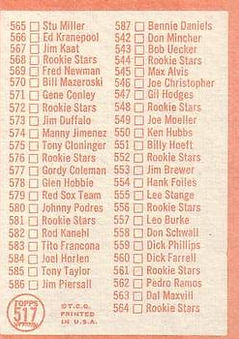

The series 7 checklist appears in series 6, and can be found in two varieties - on one, the numbering on the reverse erroneously picks up at 565, runs through 587, and then covers 542-564. On the corrected version the numbering runs 542-587 as it should. One version was likely printed with series 6 and the other with series 7, but we don't know which was with which.
Series 7: 523-598
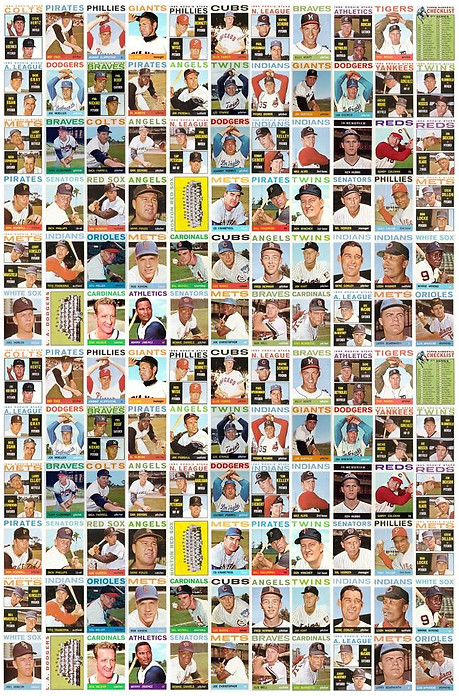
RECONSTRUCTION
RECONSTRUCTION
With only 66 cards (65 unique because the series 7 checklist is a 6th series card), series 7 was printed in blocks of 6 11-card rows. Each slit is identical, and there are no short- or over-printed cards. While in less supply that cards from earlier series, 1964's "high numbers" are not nearly as scarce as in some other years. Of the 65 unique cards, only 45 are individual basic player cards, the rest belonging to specialty subsets.
Series 7 contains the Dodgers and Red Sox team photo cards.
Series 7 includes the final two manager cards - Alvin Dark/Giants and Gil Hodges/Senators.
Series 7 contains 11 team-specific 2-player Rookie Stars cards - Reds, A's, Twins, Mets (x3), Braves, Colt .45s, Indians, Phillies and Yankees.


Series 7 also includes four league-specific 2-player Rookie Stars cards - two each for the A.L. and the N.L.


Continuing 1964's unique funereal tone, card 550 is a memorial to Ken Hubbs, a young Cubs star who perished in a plane crash early in the year.
Considering the other players who have died during their active careers (Thurman Munson, Lyman Bostock, Danny Thompson, etc.), it seems odd and perhaps even a little disappointing that only in 1964 did Topps seem interested in acknowledging these tragedies.


Hall of Famers Dick Allen (243) and Phil Niekro (541) debuted in 1964, as did Mickey Lolich (128), Tommy John (146), Lou Piniella (167), Tony Conigliaro (287), Rico Carty (476) and Willie Horton (512).


Making their last appearances in 1964 are Hall of Famers Duke Snider (155) and Minnie Minoso (538), as well as Bobby Schantz (278), Jim Gilliam (310), and Gus Bell (534).

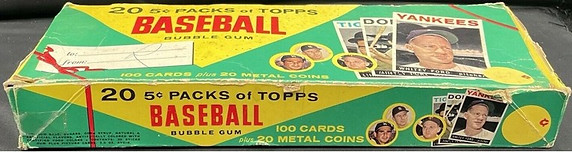
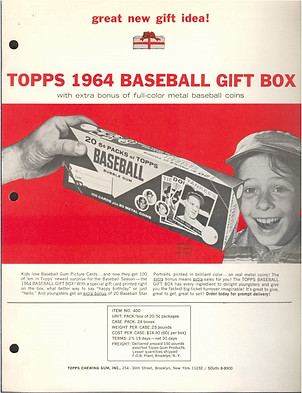
These "Gift Boxes" were a novelty in 1964. They contained 20 nickel packs (of series which contained coins, according to the box). According to the sell-sheet to the right, these were the perfect gift for birthdays, or just to say "Hello!".

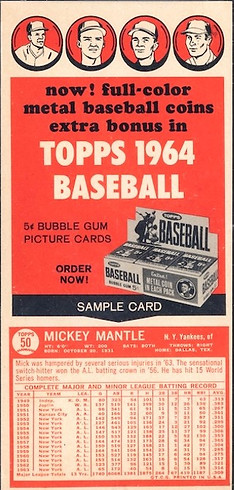
Yet again, "salesman sample" strips were distributed to entice retailers to order product. We know of three specific examples.